
Based at the Centre for Cell Biology in Edinburgh, we are an interdisciplinary research team working on all things cell-size related.
Research interests. The size of a cell is one of its most basic and fundamental properties. While the significance of cell size for cellular physiology has been appreciated for many decades, we still have a surprisingly poor understanding of the mechanisms that couple the inner molecular workings of the cell to its size.
Core cellular processes must be coordinated with cell size to sustain a cell’s ability to grow and function optimally. For instance, protein and RNA amounts, as well as organelle volumes, increase continuously during the cell cycle in proportion to cell size, even though the template DNA genome does not (see insert right). This is critical to all aspects of cell function as it keeps macromolecule concentrations constant to ensure that reactions and core cellular processes are maintained at a constant rate as cells vary in their size. Thus, a major and long-standing question in cell biology has been: how is the production of macromolecules regulated to ensure this coupling with cell size?
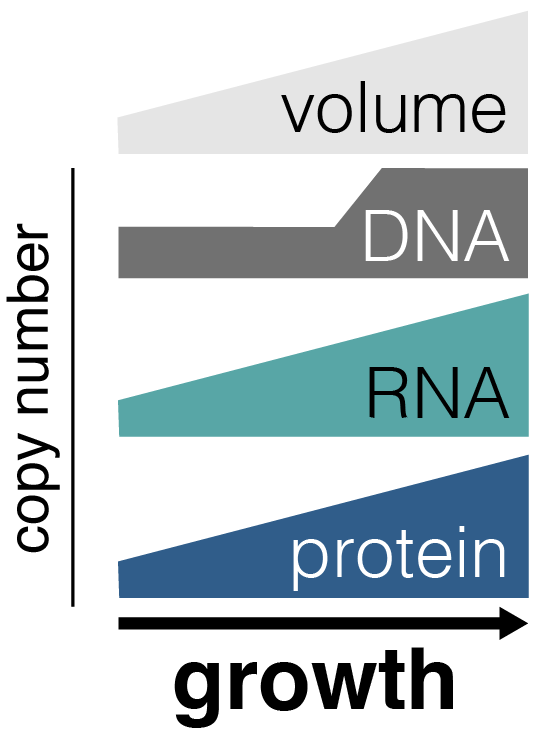
We will be employing molecular and systems approaches to study how global gene expression, RNA processing, proteome homeostasis and cell division are regulated as cells grow and increase in size. Addressing these questions requires us to build a more quantitative view of how the central dogma plays out in vivo and this is one major theme of our work. To do this we will take an interdisciplinary approach that combines functional genomics, proteomics, imaging and computational biology and utilise both yeast and mammalian cell lines as model systems. Check out our publications for more details!
Recent and future research. Recently we proposed a new model (Swaffer et al., 2023; video summary here) where the equilibrium kinetics of dosage-limiting RNA polymerase II underlie the increase in global mRNA transcription with cell size (see insert below; left). However, this scaling is not directly proportional to size which led us to discover that global mRNA turnover is additionally regulated to ensure mRNA scaling with size (see insert below; right).
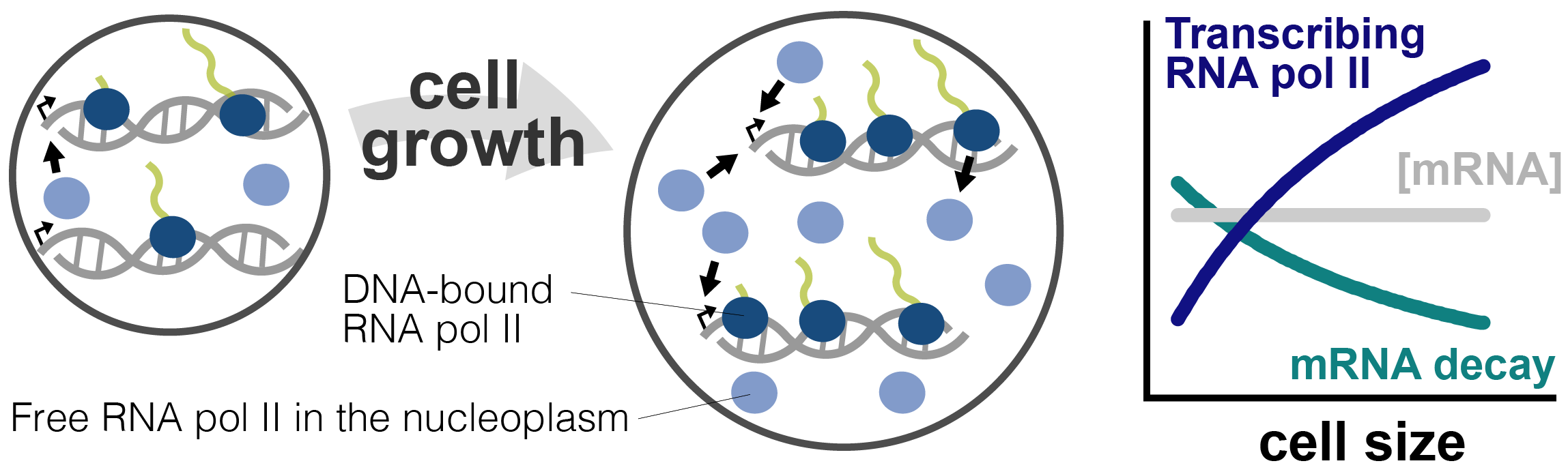
These results raise several important questions about how cellular biosynthesis is scaled with cell size that we plan to pursue. What are the molecular mechanisms that adjust mRNA turnover in larger cells? Is there an upper limit on this balancing act between transcription and decay and, if so, what are the consequences when it is reached? How do size-dependent changes in mRNA synthesis and turnover impact global proteome homeostasis? How does altered cell size impact other aspects of genome function including chromatin organisation? How conserved are these mechanisms across species and are similar processes at play to coordinate tRNA and rRNA production with the size-scaling of mRNA?
Cell size changes are also associated with many physiological and pathological transitions such as tumorigenesis, senescence, ageing, stem cell renewal, polyploidy and differentiation (see insert below). As such, we are also interested in exploring how our work on cell size may provide critical new perspectives into these and other situations.

In more general terms, we are always thinking about new and fresh ways to bring quantitative approaches to examine different aspects of cell biology through the lens of cell size. So, if you are interested in joining our team as a student or postdoc to work on the above or any other cell size or cell cycle related-questions, then please do get in touch!
 Swaffer lab